

Connect the pathway.
Without motors, batteries, air tanks or another external power source, quick-release tethering connects one limb, or one side of a tool, to the other side through a single retractable cord.


.jpg)

AORTER takes its name from the Ancient Greek ἀορτήρ (aortēr): the ancient sling the Greek Hoplites used to wield their sword and shield.
The sling from which the sword and shield were hung.
Modern webbing and clips for carrying items, including limbs.
Wearable support mechanisms expanding human assistance.
The evolution of the arm sling.


AORTER creates a continuous bilateral pathway between two working sides. The wearer remains the source of movement. The pathway redirects that movement so force generated on one side can become usable support on the other.
Without motors, batteries, air tanks or another external power source, quick-release tethering connects one limb, or one side of a tool, to the other side through a single retractable cord.
Wearer-generated movement travels through the central mechanism. When one side pulls down, the connected state changes across the opposing side. In simple terms, downward force on one side can create upward assistance on the other.
Movement and force remain connected from dominant to dependent side. The task stays fluid while the bilateral pathway shares, resists, and returns demand as the arms or connected tool move. Response depends on attachment position, routing geometry, resistance, and the task being performed.
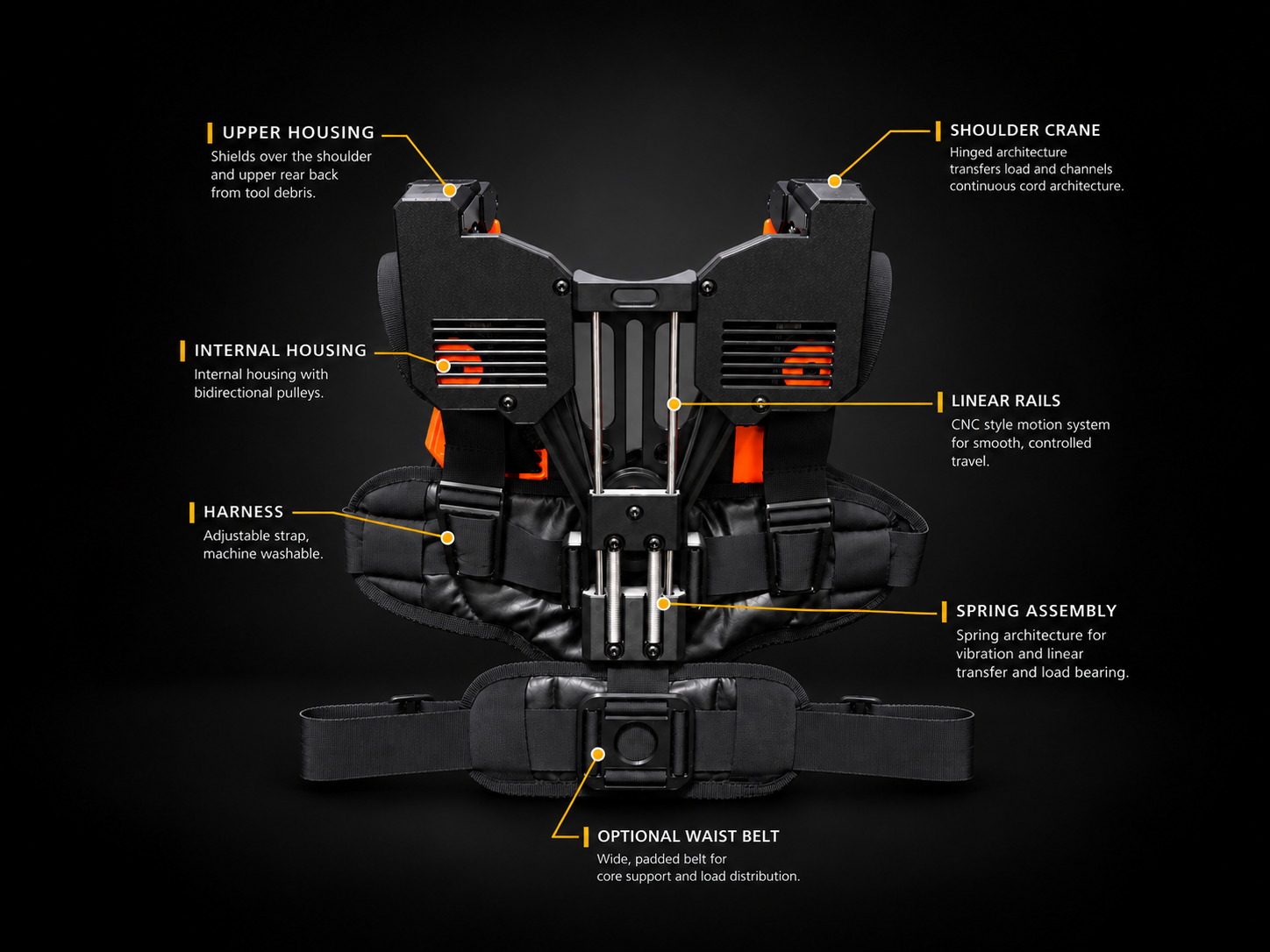
Springs, linear bearings and pulleys create the mechanical advantage behind the fluid bilateral response. The pathway can be configured arm-to-arm, arm-to-tool or tool-to-tool depending on the task and attachment position. The configuration supports up to 30 lb (AORTER CORE) through the waist-to-chest working range. Support depends on routing, attachment position, resistance and the task at hand.
ARM ↔ ARM — The opposing arm and tricep provide the active counter-pull while the pathway redirects that effort to the other side.
The patented continuous node network uses routing geometry, movable sheaves, guided travel and selected resistance to change how wearer-generated force is shared through the pathway. This utility is granted and protected under the United States Patent Office.
A single cord tracks around tension-adjustable sheaves, with free ends on opposite sides and at least one movable central sheave carried by a linear track bearing.
Fixed left/right redirectional sheaves and movable central sheaves may be adjusted independently; spring-loaded linear bearings provide resistance as the sheaves travel.
Flexible tubes guide the cord, hinged supports direct its free ends, and the cord may be anchored or stretchable according to the claimed configuration.
The lift-assist claim combines redirectional and movable central sheaves, resistance-equipped linear bearings, free cord ends and hinged shoulder routing.
The hands control the task, but they do not have to carry every demand alone. AORTER begins at the wrist, forearm, hand or equipment interface and redirects load into a connected pathway through the body.
In arm-to-arm configurations, the opposing tricep and extension chain can create the counter-pull, sharing demand across both sides instead of leaving one arm to manage the task alone.
Routing, tether position and resistance can shift demand away from a single overloaded point and into larger connected muscle chains, helping the arms stay available for positioning, control and repeated work.
AORTER is designed to share sustained holding and repeated-load demand through the pathway, so the arms spend less of the task continuously supporting the full load and more of the task controlling it.
Select a position to compare how the shoulder exits can route support toward the hands, wrists or an attached load.
Two taut tethers terminate at the supported load so the hands can steer, carry and reposition it through the configured range.
The wearer stays inside the force loop. AORTER continuously couples the two working sides, using the mechanical pathway to share changes in load instead of asking the user to stabilize every change with one limb alone.
The system is designed around a bilateral equilibrium zone, including near 50/50 sharing when the task and configuration allow it. Spring travel, routing and the control module can absorb and redistribute portions of changing tension and vibration, while the wearer remains free to steer, position and respond. AORTE is researching how this connected physical feedback affects coordination, perceived effort and cognitive demand.
The same spring-and-routing architecture that shares load can also attenuate portions of tool vibration and oscillating tension before they are carried entirely by the arms. The goal is less unnecessary stabilizing demand at the human interface, not a medical treatment claim.
Wherever the continuous cord terminates, the pathway responds to that working end. It may finish at the load, both hands or one working arm, allowing the tether to follow the movement while carrying tension through the same bilateral route. Every interchangeable pathway is configured around the task, attachment, load and working range.
Terminate the pathway at the object and the load itself becomes the working end. A configured tool or object can remain supported while the hands release, regrip or manage another part of the task.
Tools · instruments · trays · tower work · carried equipment · performance gear
Terminate the pathway at the hands or wrists and both arms remain inside the bilateral route. The tether follows lifting, carrying, alignment and positioning while the wearer remains responsible for the movement.
Material handling · assembly · landscaping · rehabilitation · sport · general task support
Terminate both tether ends around one arm and the bilateral route can be redirected toward a primary side, sustained hold or professionally directed return-to-work pathway.
Recovery · shield or tool support · side-impact drilling · gardening · asymmetric task development
The same workday can demand a prolonged hold, rapid task changes and continuous material handling. AORTER configurations are assessed around how often the load moves, how long it is held and how quickly the user must transition.
Time under tension does not have to begin with a heavy object. A lighter tool held, guided or stabilized for hours can create its own sustained arm demand. AORTER can be configured around lighter-duty as well as heavier-duty work when the tether path remains clear and the user must stay in control.
If you hold your arm or a tool in position for a specific task, bring it to us.We can help determine whether AORTER can carry part of that demand.
AORTER CORE is our flagship unit.
AORTER CRANE is our heavy-duty workhorse.
AORTER CUSTOM is built for solving unique workflows.
Please see below


AORTER excels at industrial support pathways for lifting, steering, tool handling and precision work. The result is measured where the work is felt: fatigue, control, task continuity and workflow fit.
Lorem ipsum dolor sit amet, consectetur adipiscing elit.Industry testimonial · placeholder
The attachment determines where support enters the task. Arm tethering shares demand while the tooling expert keeps the equipment in hand. Direct tool tethering moves support to the equipment itself, allowing a configured tool to remain suspended when the hands release it. Hybrid routing combines both. The pathway changes with the workflow without asking the operator to surrender steering, reach or control.
The arms and held object remain one moving mass. AORTER applies assistance through the limbs, reducing the residual demand the tooling expert must carry.
The tether connects to the equipment. Within the configured support range, the tool can remain suspended while the expert releases, regrips or changes position.
Arm and tool attachments can be combined around the workflow when the task requires both limb assistance and secured equipment.
Arm-to-arm tethering supports bilateral lifting, carrying, aligning and placement as the load moves from below the waist toward the upper chest. The pathway follows multi-plane movement instead of restricting the user to one fixed lift.
Reduce the cost of inverted grip. Awkward polyaxial work and one-sided loads can force the forearm into sustained rotation while the hand maintains control. A configured arm or direct-tool tether can support part of the mass so the expert can reposition the grip without abandoning the task.
Build it into your workflow. Power-tool manufacturers, PPE and safety suppliers, industrial distributors, ergonomics teams and employers can work directly with AORTE on demonstrations, attachments, distribution and task-specific configurations.
When vibration, reach and long-duration handling collide, professional lawn care finally has support that moves with the operator. Powered equipment stays mobile, steerable and under control through the work.
We are very happy with the skelet.Filip Laureys · 't Groenenhof · Belgium · LandscapingWatch the client video →
AORTER takes the load of trimmers, blowers, weed eaters, powered pruning tools, hedging equipment and arborist equipment through changing angles while the user continues steering and positioning the work. It creates continuous follow-through without interrupting the workflow. Direct attachment supports the tool itself, creating a mobile suspension point instead of asking the arms to hold its full weight between movements.
Connect support to the equipment when tool weight, vibration and time under tension accumulate.
Maintain reach, sweep, trim and repositioning through a changing outdoor workflow.
Long-handled tools turn reach into time under tension. Shovels, rakes, window-cleaning poles, sprayers and similar equipment can be supported without a motorized tool interface, using arm-to-arm, arm-to-tool or tool-to-tool routing selected around the movement the job already requires.
When our lives depend on the knowledge and precision of another person, their hands and arms deserve every mechanical advantage available. AORTER can stabilize the limbs across multiple working ranges for surgery, patient handling and other precision-based applications.
Lorem ipsum dolor sit amet, consectetur adipiscing elit.Clinical testimonial · placeholder
Stationary clinical workflows can create prolonged time under tension even when the carried load is small. AORTER development pathways support sustained arm positioning, controlled equipment placement and management of tool vibration where precision matters.
Support the arms through prolonged stationary procedures without fixing them to one plane.
Assist controlled placement and handling while the clinician retains direct movement control.
Clinical collaboration. Hospitals, surgical teams, occupational-health departments and medical-device partners can work with AORTE to define a procedure, measure time under tension and develop a purpose-fit support pathway.
Care work cannot become less human just because support is added. Caregivers, nurses and porters still have to move between rooms, beds, units and homes, change direction and respond to another person in real time. Mobile configurations can assist repositioning, rolling, stretcher work and equipment handling while preserving that freedom.
When mission equipment consumes the arms, it also consumes response capacity. AORTER supports the load before fatigue takes control, preserving movement, positioning and readiness for first responders and the soldiers who protect our country.
This belongs with the Special Forces.Colonel and Base Commander
Mobile assistance can support fire hoses, stretchers, breaching tools, heavy rescue equipment and casualty movement while the responder retains steering and control. Modular quick-release pathways can shift support from approved equipment to a limb interface when the response changes, including using a stronger limb to assist a newly dependent arm or leg during extraction.
Response time matters most when the load is already in the way. Purpose-fit tethering can support protective shields, breaching equipment, non-lethal equipment, field logistics and other approved loads while preserving rapid repositioning. Public-safety and Defence integration requires task-specific assessment, validation and authorization.
Discuss a public-safety or Defence-support pathway →
Explore Rescue + Defence R&DOriginally conceived as a space-fitness system, the KRA uses balanced resistance and bilateral coordination around a 50/50 equilibrium state. That same mechanical principle can support professional sport conditioning, AgeTech, accessibility and professionally directed rehabilitation.
Lorem ipsum dolor sit amet, consectetur adipiscing elit.Sports + rehabilitation testimonial · placeholder
AORTER was first conceived as a force-output system for boxing and gravity-invariant space applications. An athlete, for example, still moves real mass: the arms, the wearable and any attached training equipment. The bilateral mechanism adds configurable tension to that moving mass without reconfiguring a weighted vest or anchoring the athlete to a cable station.
Add mobile resistance through the punch, return, guard and footwork while preserving the athlete’s freedom to move.
Configure upper- and lower-limb tethers around stride, arm drive, acceleration and coordinated force output. Hiking and cross-country applications can add upper-body resistance, support carried equipment or enable shadow-form conditioning in the off-season.
Explore supported cameras, telescopes, binoculars and field-observation equipment through steadier carrying, positioning and movement measurement.
Resistance travels with the user for walking, jogging, controlled movement and general conditioning. Outward movement creates a bilateral challenge while inward assistance can support the return pathway. Configurable assistance and resistance can support progressive movement and professionally directed rehabilitation.
Research invitation. Hospitals, rehabilitation programs, clinicians and human-performance laboratories can work with AORTE on gait, bilateral coordination, upper-limb support and professionally supervised movement research.
Discuss a health-system research pathway →
Our small Canadian team prepares each AORTER with direct quality inspection from fit through final assembly. Additive manufacturing keeps the mechanical architecture under our control and allows rapid customization, precise component changes and task-specific configurations without depending on generic mass-production tooling. Textile assemblies are cut, sewn and finished in-house on industrial equipment, then each complete unit is inspected around its intended fit and workflow.
Built in small batches by design. CORE is our mobile flagship, CRANE is our heavy-duty workhorse, and CUSTOM solves purpose-fit attachment and workflow requirements. The result is a more personal build with direct configuration support and craftsmanship carried through the complete unit. Send an enquiry
The compact pathway keeps the tool suspended close to the wearer while following fast, mobile movement. It suits high-mobility work, frequent repositioning and task changes without placing structure above the head.

LAUNCH SALE · SAVE 20%
Regular price $2,770 CAD · Save $554 CAD
Ends October 30, 2026 at 11:59 p.m. Eastern Time. AORTER CORE only. Taxes and shipping extra. Sale eligibility and production availability will be confirmed in your quote before payment.
Configure CORE & request quoteView Sizing & MeasurementsAlpha-release construction. Current units combine high-grade additive-manufactured components, professionally sourced linear systems, heavy-duty spring sets, standard metric hardware and hand-sewn textile assemblies. Configuration varies by wearer and task.
The elevated pathway can be configured for greater lift capacity, a higher working range and farther forward reach. It suits heavier, stationary and precision tasks while keeping the tool suspended.

The elevated CRANE tether path can approach face level. Keep the face clear of the tether path and use impact-rated protective eyewear during configuration and operation.
Alpha-release construction. Current units combine high-grade additive-manufactured components, professionally sourced linear systems, heavy-duty spring sets, standard metric hardware and hand-sewn textile assemblies. CRANE height and tether response are configured around the wearer and operating range.
20–34-inch waist · Unisex
30–44-inch waist · Unisex
Measure before ordering. These waist ranges guide standard sizing. Shoulder width, chest and torso fit also determine whether the physical frame and support structure will suit you. If your waist falls in both ranges, our team will help select the frame.
Prepare your measurements. Tell us your height, intended task and the clothing or protective equipment you will wear with AORTER. Measure your actual body circumference around the intended belt position over that clothing, keeping the tape level and comfortably snug. Do not use the size printed on your pants. Send the measurement in inches or centimetres.
Check your back length. The current standard frame is intended for an approximate 17–24-inch back-length range. Measure vertically from the base of the neck, where the upper frame will sit, to the intended waist-belt position. This is a preliminary compatibility check, not a substitute for confirmation by our team.
Check the upper-frame opening. The current opening between the shoulder structures is approximately 8 inches wide. Measure the widest body or protective-equipment profile that must pass through that opening while putting the unit on. This is a straight-line clearance measurement—not neck circumference—and a measurement equal to the full 8-inch opening is not automatically an acceptable fit. Our team must confirm safe clearance before an order proceeds.
Confirm the frame with us. Before you order, we can provide the relevant physical frame dimensions and guide your chest, shoulder-width and torso measurements. Our team will confirm neck and shoulder clearance, fit, attachment position and working range. CRANE height is configured relative to the shoulder and eye level.
Need a larger or specialized frame? Standard models are limited by their physical framing and support structure. Larger shoulders, waist measurements outside these ranges, or specialized fleet requirements may need tailored development through AORTER CUSTOM. Contact us with your requirements, particularly for fleet or industrial orders, so we can assess feasibility and quote the work.
We are a small Canadian business and will work with you to get the fit right before you order. Custom sizing is assessed individually and is subject to an agreed configuration, price and development schedule.
Confirm My MeasurementsSmall business. Hand-tailored. Professional-grade components. Each AORTER is assembled and tailored by hand by our small Canadian team, with care focused on fit, craftsmanship and function.
Alpha-release enquiries are open. We will confirm the next available production window before accepting payment. When a window is offered, the anticipated dispatch estimate is 30–60 calendar days from payment and confirmation of measurements and configuration. Your written confirmation will state the applicable estimate. Shipping transit time is additional.
Please anticipate plain protective packaging. Your unit is individually prepared for its agreed configuration.
AORTER CUSTOM: The separate iterative development service follows its quoted schedule, rather than the standard 30-day preparation estimate.
Shipping: Your delivery charge and available service will be confirmed before payment. Destination import charges, where applicable, are separate unless included in your written quote.
Purpose-fit alpha development. AORTER CUSTOM combines additive manufacturing, professionally sourced mechanical systems and hand-sewn textiles with documented configuration decisions around the task, wearer and operating environment.
No software commissioning, charging routine or compressed-air supply. Fit, tension and tether position are established around the wearer and task.
Standard sizing is confirmed against waist, shoulder clearance, torso dimensions, attachment position and working range.
Cords, sheaves, rails, springs, clips, strapping and padding remain accessible for inspection. Service needs depend on load, contamination and cycle frequency.
The task determines the tether and mechanical setting. A new interface can be assessed through AORTER CUSTOM when the standard configuration does not fit.
CORE supports mobile work from below the waist to the upper chest. CRANE adds wearer-specific higher positioning, typically from two inches above the shoulder to below eye level. CUSTOM extends either architecture around a specialized workflow.
Mobility first. Lightweight support for dynamic and polyaxial work from below the waist to the upper chest.
Higher positioning and sustained support. The crane height is configured relative to the wearer and task.
Configuration package. A three-month iteration service for purpose-fit tethers, clips, attachments and interfaces.
AORTER construction is configured around the model, wearer, task and operating environment.
Configuration note. Materials and components are selected according to the intended use case, fit, environment, model and customization requirements. Final specifications may vary by configuration.
Configured for mobile upper-body support from below the waist to the upper chest. It follows multi-directional movement without positioning a crane beside the head.
Crane height is configured relative to the wearer. Its typical fixed range extends from approximately two inches above the shoulder to below eye level.
The CRANE can be raised for task-specific applications only after configuration review. Greater reach becomes an AORTER CUSTOM package, where lumbar and trunk support are typically assessed and specified.
Lift assistance describes the configured supporting force provided through the tether pathway. It is not the maximum load a person may safely lift and does not replace task assessment or proper lifting practice.
Passive assistance for configured limb, tool and load-support tasks within the working range supplied for the selected model and wearer.
AORTER is not a fall-arrest system, climbing harness, lifting hoist or substitute for required workplace PPE.
Do not use damaged, worn, improperly fitted or unauthorized components. Check cords, tether points, locks, clips, belts and fasteners before every use.
Do not exceed the supplied working range or alter the tether path without written configuration guidance. AORTER does not make an otherwise unsafe task safe.
Direct arm tethering continues to surface in distributor conversations, workflow evaluations and industrial musculoskeletal-safety analysis. AORTE Fitness is opening collaboration with partners who recognize a commercial application for CORE, CRANE or the underlying mechanical architecture.
Bring AORTER into a defined workflow, evaluate the task and configure the support around the operator and working range.
Discuss a deployment →Bring AORTER to your market through a distribution relationship built around commercial demand, fit and mutual collaboration.
Become an AORTER distributor →License the granted Kinetic Resistance Apparatus architecture for research, robotics, human-machine systems and next-generation mechanical applications.
Research + Development →Seven international markets are represented below. Distributor information will be released as relationship agreements are finalized.
Tell us the load, the working position and where fatigue interrupts the task. We’ll help you choose the support and confirm fit, availability and pricing.
This website summary should be reviewed against the final written sales terms before automated online payment is enabled.
A website enquiry or order request is not accepted until confirmed in writing by AORTE FITNESS INC. A quotation, invoice or order confirmation may specify configuration, lead time, payment, tax, shipping and additional terms.
Prices are shown in Canadian dollars unless stated otherwise. Applicable taxes, shipping, duties, brokerage, accessories and specialized services are additional unless expressly included.
Purchasers are responsible for providing accurate fit, task and use information. A fitting conversation, demonstration or task review may be required before a specialized order is accepted.
Orders that have entered fabrication, customization or procurement may be non-cancellable or subject to documented costs. Custom configuration services and purpose-built components may be non-refundable once work begins.
Orders are prepared by enquiry. Before payment, AORTE will confirm availability and the estimated dispatch window. When a production window is available, the anticipated CORE and CRANE estimate is 30–60 calendar days from payment and fit/configuration confirmation. Transit time is additional; CUSTOM development follows its quoted schedule. Shipping dates are estimates until confirmed. Buyers are responsible for accurate delivery information and, unless expressly included, destination taxes, duties, brokerage and import charges.
Inspect shipments promptly on arrival and report visible transit damage, missing components or material order discrepancies as soon as reasonably possible.
No return should be sent without authorization. Returned standard products must be clean, complete, unmodified and in resalable condition. Worn textiles, contamination-sensitive items, custom-fit components, purpose-built attachments and CUSTOM service work may be non-returnable except where required by law or covered by warranty.
Any return window, restocking fee and return-freight responsibility will be stated in the accepted written order terms. Nothing here limits non-waivable statutory rights.
AORTE FITNESS INC. provides 12-month limited warranty coverage from the documented date of purchase on covered AORTER hardware against defects in materials and workmanship, subject to the written warranty supplied with the product.
The warranty does not cover normal wear, consumable or replaceable wear items, improper fit, misuse, overloading, impact damage, contamination, neglect, unauthorized repair or modification, incompatible accessories, use outside written instructions, or damage caused by an unsuitable task or environment. Use must remain within the assessed connection, load, support configuration and working range supplied for the intended task.
Subject to applicable law and the written warranty, remedy may include inspection, repair or replacement. Proof of purchase and return authorization may be required.
Unless expressly stated in writing, purchase does not guarantee a specific ergonomic, medical, productivity, injury-reduction or clinical outcome.
Enquiry and order forms may collect contact details, organization, task information, product interest, fitting preference and information voluntarily provided.
Information may be used to respond to enquiries, evaluate product fit and task suitability, prepare quotes or orders, provide support, maintain business records and meet legal obligations.
Information may be shared with service providers only as reasonably required for fulfilment, support, shipping, professional services or legal compliance, and retained as reasonably required for those purposes.
Privacy enquiries can be sent to exo@aortefitness.com.
AORTE FITNESS INC. intends this website to be usable by as many people as practical. The site supports keyboard navigation, responsive layouts and reduced-motion preferences where supported.
If you encounter a barrier accessing product, ordering or support information, contact exo@aortefitness.com or call +1 519 381 3099 and request the information in an alternate format.
AORTE FITNESS INC. owns the Kinetic Resistance Apparatus patent and develops AORTER for industrial, ergonomic, sport, research, rescue, public-safety, protective-support and mission-equipment applications.
The commercial website centres on human performance, mobility, load carriage, stabilization, sensing, optics, communications, protective systems and equipment positioning under direct user control.
Defence departments, public-safety agencies, research institutes and systems integrators are invited to discuss protective-support, logistics, rescue, human-machine interface, robotics and mission-equipment applications under appropriate governance and agreements.
AORTE FITNESS INC.’s ownership of the Kinetic Resistance Apparatus patent does not mean that AORTE FITNESS INC. develops or offers every technically conceivable application of that patent. Defence references on this website concern mission equipment, rescue, protective loads, logistics, training, human performance, sensing, mobility and public safety.
This notice describes corporate scope; it is not a regulatory determination. Any controlled-goods, military, dual-use, export-controlled or other regulated activity requires independent legal and regulatory review before technical information, goods or services are examined, transferred or supplied.
AORTER products are wearable assistive systems and must be used only in their intended configuration, within published load, fit and operating guidance. Users remain responsible for safe work practices, proper lifting technique, task assessment, inspection and workplace procedures.
Website content is general information and is not medical advice, diagnosis or treatment. Consult an appropriate physician or qualified healthcare professional before medically directed use.
Specifications, pricing, availability, configurations and imagery may change. Statistics shown in website panels that link to third-party research are provided only as industry context. They are not AORTER performance results, product test results or claims that AORTER will reproduce those outcomes.
Join the AORTER mailing list for product news, research updates, launch offers and occasional company announcements.


